
AI Governance
Built for Governed AI
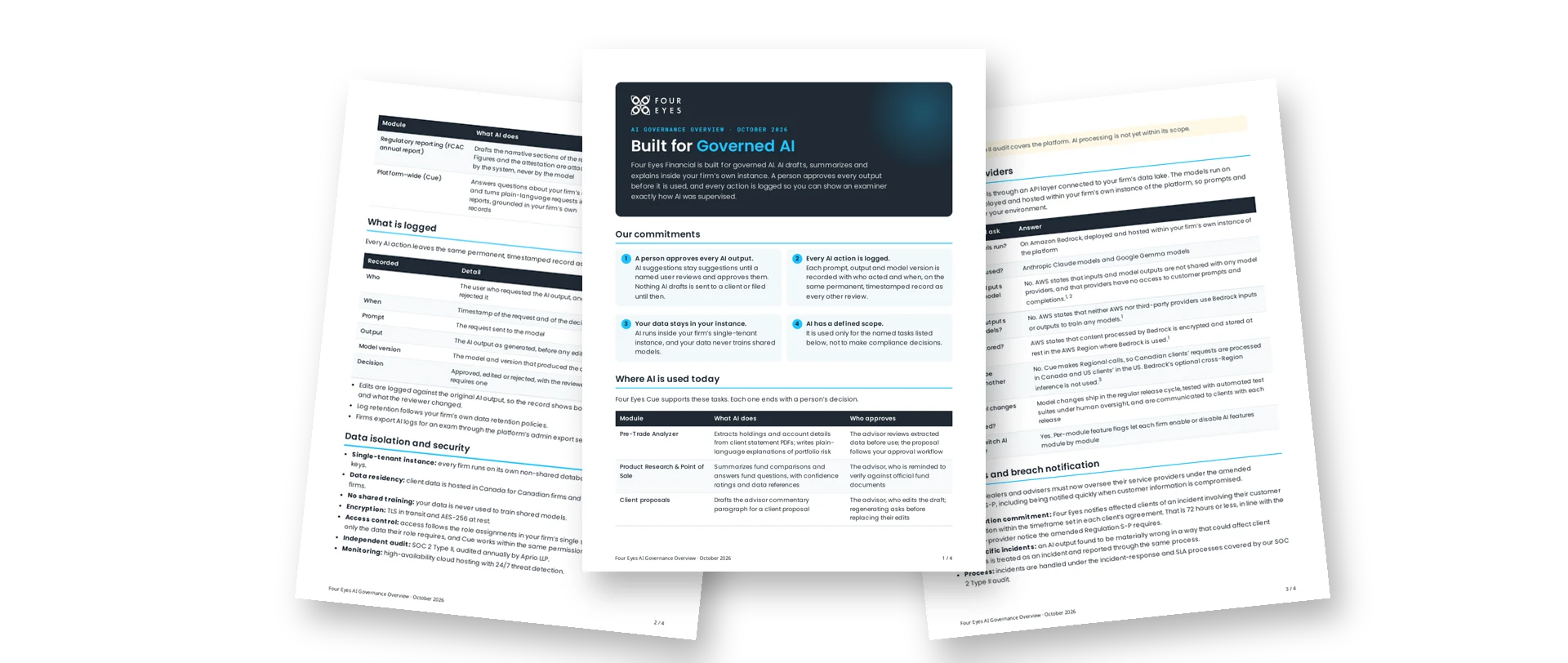
The Four Eyes Financial client compliance lifecycle platform is built for governed AI. AI drafts, summarizes and explains inside your firm’s own instance. A human approves every output before it is used, and every action is logged so you can show an examiner exactly how AI was supervised.
Governed AI Architecture
Four Pillars of Supervised AI
A human approves every AI output
AI suggestions stay suggestions until a named user reviews and approves them. Nothing AI drafts is sent to a client or filed until then.
Every AI action is logged
Each prompt, output and model version is recorded with who acted and when, on the same permanent, timestamped record as every other review.
Your data stays in your instance
AI runs inside your firm’s single-tenant instance, and your data never trains shared models.
AI has a defined scope
It is used only for the named tasks listed below, not to make compliance decisions.
AI-Powered Compliance Workflows
Five Workflows
Governed by Human Oversight
Unified Governance & Logging
One Audit Trail
for Human and AI Oversight
Single-Tenant Data Sovereignty
Your Data Stays
in Your Instance
Regulatory Alignment
Evidence of Human AI Oversight
Regulator expectation
How Four Eyes supports it
CIRO 2026 Annual Compliance Report: CIRO will ask dealers how they use AI and review the controls that ensure it works as designed. Dealers should document their AI use and consider whether it is a material business change that needs notice to CIRO
AI is limited to five named workflows, each switchable by module with feature flags, and every prompt, output and model version is logged, giving you a documented inventory of AI use and evidence it works as designed
CSA Staff Notice 11-348 (AI in capital markets): governance and risk management for AI, including testing, human oversight, data integrity and supplier evaluation
A human approves every output, model changes are tested in each release cycle, and models run on Amazon Bedrock inside your instance with no model-provider access to your data
SEC examinations test that AI claims are accurate and that firms supervise AI use, including vendor tools
AI scope is defined and limited to named tasks, and every output has a named approver
FINRA guidance on generative AI: keep humans in the loop, log prompts and outputs, track model versions, validate outputs
Human approval on every output; prompts, outputs and model versions logged, with edits recorded against the original output
Supervision under FINRA Rule 3110 and books and records under SEC Rules 17a-3 and 17a-4
AI actions sit on the same permanent, timestamped record as every other review
Safeguarding customer information under Regulation S-P
Single-tenant instance, encryption, role-based access and no shared model training
Frequently Asked Questions
AI Governance FAQs
What is AI governance for wealth management compliance?
AI governance means every AI output used in compliance work is limited to defined tasks, approved by a human and logged for examiners. In Four Eyes, AI drafts, summarizes and explains inside your firm’s own instance, and every action lands on the same permanent audit trail as every other review.
How does Four Eyes keep a human in the loop on AI?
A human approves every AI output before it is used. AI suggestions stay suggestions until a named user reviews and approves them, and nothing AI drafts is sent to a client or filed until then.
What does Four Eyes log for each AI action?
Every AI action records who requested and approved it, when, the prompt, the output as generated, the model version and the decision. Edits are logged against the original output, retention follows your firm’s policies, and logs can be exported for an exam through the admin export settings.
Which compliance workflows use AI in Four Eyes?
Five workflows use AI, each ending with a human decision: Pre-Trade Analyzer, Product Research & Point of Sale, client proposals, regulatory reporting (the FCAC annual report), and Cue’s platform-wide questions and bespoke reports.
Where is client data hosted, and who can access it?
Client data is hosted locally within your operating jurisdiction, in your firm’s own single-tenant instance. Both your staff and Cue are strictly bound by role-based access control (RBAC) configured through your single sign-on (SSO) system.
How does Four Eyes support CIRO, CSA, SEC and FINRA expectations for AI?
Four Eyes gives your compliance team evidence that AI supervision works: AI is limited to named workflows, a human approves every output, and prompts, outputs and model versions are logged. That supports CIRO’s review of dealers’ AI controls, the governance expectations in CSA Staff Notice 11-348, and SEC and FINRA expectations for supervising AI, including vendor tools.
Where do Cue’s AI models run, and which models are used?
Cue reaches AI models through an API layer connected to the Four Eyes data lake built into your firm’s instance of the client compliance lifecycle platform. The models, Anthropic Claude and Google Gemma, run on Amazon Bedrock, deployed and hosted within that same instance, so prompts and client data stay inside your environment.
Are prompts or outputs shared with model providers or used to train models?
No. AWS states that inputs and model outputs are not shared with any model providers, that providers have no access to customer prompts and completions, and that neither AWS nor third-party providers use Bedrock inputs or outputs to train any models (Amazon Bedrock FAQs).
Where is AI data stored and processed?
AWS states that content processed by Bedrock is encrypted and stored at rest in the AWS Region where Bedrock is used. Cue makes Regional calls, so Canadian clients’ requests are processed in Canada and US clients’ in the US. Bedrock’s optional cross-Region inference is not used.
How are model changes tested, and can AI be switched off?
Model changes ship in the regular release cycle, tested with automated test suites under human oversight and communicated to clients with each release. Per-module feature flags let each firm enable or disable AI features module by module.
Download the PDF
Take It to Your Committee
Get the four-page AI Governance Overview as a PDF for your compliance, security or vendor-review committee.
What Happens Next
01 · Share your details
Name, firm and email, nothing more.
02 · Download instantly
The PDF opens as soon as you submit.
03 · Talk to us if you like
Book a demo to walk your compliance and security teams through Cue.
Download the Overview
Fields marked * are required.
We’ll only use your details to respond to your inquiry. See our Privacy Policy.