
For RIAs & Dually Registered Firms
Advisory and Brokerage Side by Side
Without Mixing Obligations
Four Eyes Financial manages the complete client compliance lifecycle for RIAs and dually registered firms, from digital account opening and pre-trade suitability to drift monitoring, trading surveillance and casework. Advisory accounts follow the Advisers Act, brokerage accounts follow FINRA rules and Reg BI, and every decision lands in one exam-ready record.
What Changes
One Data Layer - Two Rulebooks
Accounts opened digitally
Clients open advisory and brokerage accounts online, with each account marked advisory or brokerage and every field validated through Digital Onboarding.
Suitability before the trade
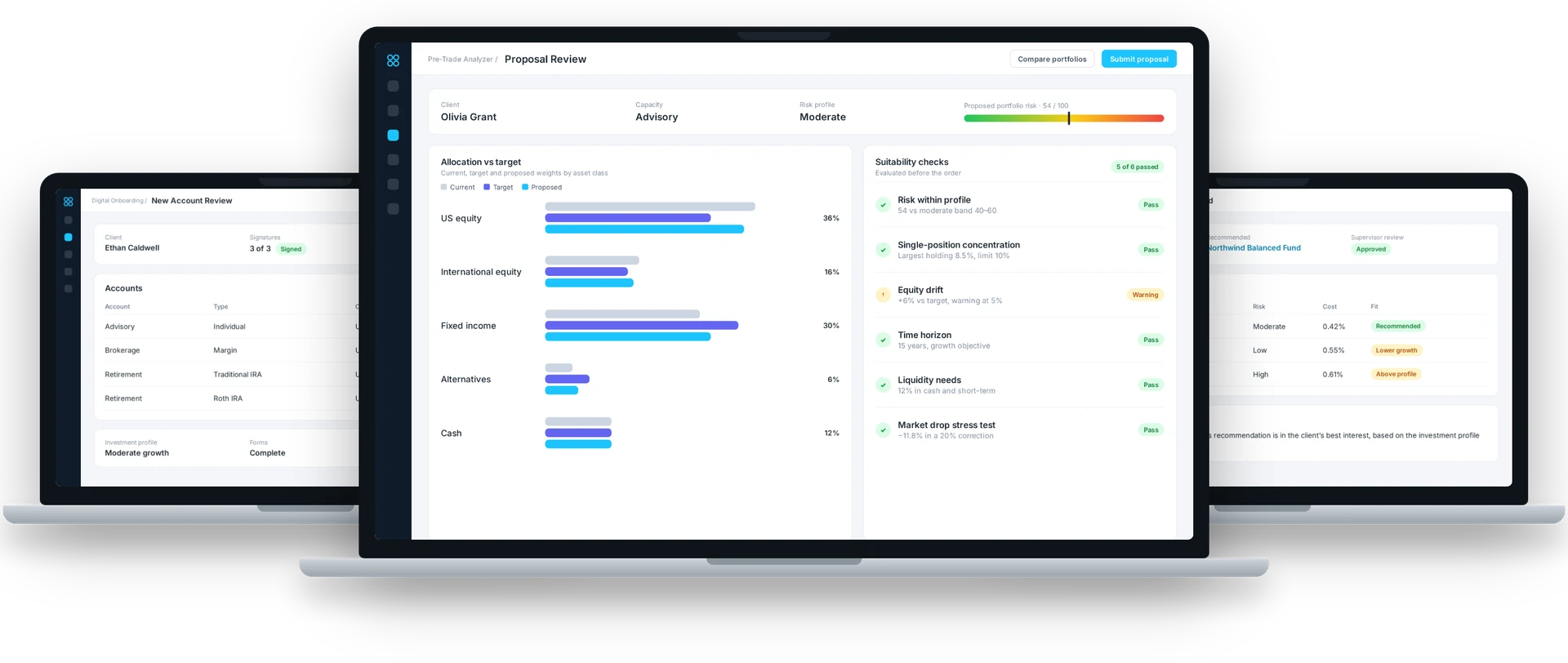
Advisors prepare proposals and model portfolio changes in Pre-Trade Analyzer, checked against the client’s profile, concentration limits and your suitability rules before placing the order.
Drift caught early
Risk7’s Mandate Drift report runs on a daily or monthly cycle you choose, flagging accounts whose allocation has drifted from the client’s risk profile and investment policy, well ahead of the next periodic review.
Advisory and brokerage surveillance
Risk7 maps alerts to Advisers Act, SEC and FINRA obligations, so advisory and brokerage activity are each reviewed under the right rules.
Value for Every Role
Tailored Value Across
Your Advisory Firm
For Advisors
Open advisory and brokerage accounts online, with clients e-signing as part of the flowPrepare proposals and model changes against the client’s profile and target allocationSpot portfolio drift before the next client reviewDocument recommendations and alternatives as part of the work
For Compliance
Unified Risk7 queues: review trade exceptions and focus solely on what requires human judgmentAdvisory accounts reviewed under the Advisers Act, brokerage under FINRA and Reg BIFirm-set thresholds kept separate from regulatory requirementsEvery review permanently logs the reviewer’s identity and timestamp
For Operations
New accounts arrive in good order, validated before submissionAdvisory and brokerage accounts on one client recordCases routed with business-day deadlinesSurveillance thresholds set by line of business
Before and After
From Two Rulebooks
to One Exam-Ready Record
Today
With Four Eyes
New account forms re-keyed and chased for signatures
Accounts opened online, e-signed and validated before submission
Drift found at the next periodic review
Daily or monthly drift checks in Risk7, on the cycle you choose, flag accounts that drift from the client’s risk profile and investment policy between periodic reviews
Suitability checked after the trade
Advisors check proposals against the client’s investment profile in Pre-Trade Analyzer before placing the order
Blotters reviewed line by line
Risk7 screens every trade and surfaces only the exceptions that need human judgment
Exceptions tracked in email and spreadsheets
Cases with business-day deadlines, secondary approval and a written rationale in Case Management
Separate reviews for advisory and brokerage accounts
One client record and one data layer with advisory and brokerage accounts each reviewed under the right rules
Regulatory Map
Mapped to Advisers Act,
SEC and FINRA Obligations
Obligation
How Four Eyes Helps
Fiduciary duty (Advisers Act)
Advisors check proposals against the client’s profile and target allocation in Pre-Trade Analyzer, and Risk7 monitors advisory accounts for drift on a daily or monthly cycle.
Regulation Best Interest
For brokerage recommendations, the client’s profile, the reasonable alternatives considered and the advisor’s attestation are recorded at the point of sale.
Compliance program (Rule 206(4)-7)
Alert parameters reflect your policies and procedures, kept separate from regulatory requirements, with every review documented.
Supervision (FINRA Rule 3110)
For brokerage activity, Risk7 screens every trade against exception types mapped to FINRA and SEC obligations, and Case Management records each review and decision.
Know your customer (FINRA Rule 2090)
Each customer’s essential facts and investment profile are captured at account opening, with each account marked advisory or brokerage.
Code of ethics
(Rule 204A-1)
Risk7 monitors access persons’ personal trading against your code of ethics, with exceptions routed for review.
Trusted contacts
(FINRA Rules 4512 and 2165)
For brokerage accounts, trusted contact details are captured at account opening, and potential client vulnerability is flagged for a person to review.
Books and records
(SEC Rules 17a-3 and 17a-4)
Brokerage records are kept with storage that meets Rule 17a-4 requirements, and every advisory review and decision is a permanent, timestamped record.
Privacy and safeguards
(Regulation S-P)
Client data stays in your firm’s single-tenant instance, encrypted in transit and at rest, with role-based access controls.
SEC and FINRA exam readiness
Every review and decision logs the reviewer’s identity and timestamp.
Built for Regulated Firms
Single-Tenant and SOC 2 Type II Compliant
Every firm runs on its own instance with unique encryption keys, with SOC 2 Type II controls independently audited by Aprio LLP, headquartered in Atlanta, Georgia.
Frequently Asked Questions
The Compliance Lifecycle Platform for RIAs and Dual Registrants
What is RIA compliance software?
Software that manages an RIA’s client compliance lifecycle in one place. For registered investment advisers and dually registered firms, Four Eyes Financial covers digital account opening, pre-trade suitability, portfolio drift monitoring, trading surveillance mapped to Advisers Act, SEC and FINRA obligations, point-of-sale records and supervisory casework on one connected data layer.
Can clients open accounts online?
Yes. Digital Onboarding lets clients open advisory and brokerage accounts, including IRAs, online, with the investment profile captured, each account marked advisory or brokerage, e-signature and every field validated before the account is submitted for approval.
How does Four Eyes handle dual registration?
By recognizing which capacity applies to each recommendation and account. Advisory reviews follow the Advisers Act fiduciary duty, and brokerage reviews follow Regulation Best Interest and FINRA rules, so dual registrants keep one client record without mixing obligations. Surveillance thresholds can also be set by line of business, such as advisory and brokerage.
Which Advisers Act, SEC and FINRA obligations does it cover?
Fiduciary duty under the Advisers Act: advisors check proposals against the client’s profile and target allocation in Pre-Trade Analyzer, and Risk7 monitors advisory accounts for drift on a daily or monthly cycle. Regulation Best Interest: brokerage recommendations record the alternatives considered and the advisor’s attestation. Compliance program (Rule 206(4)-7): alert parameters reflect your policies and procedures, with every review documented. Supervision (FINRA Rule 3110): Risk7 screens brokerage trades and Case Management records each review. Know your customer (FINRA Rule 2090): each customer’s investment profile is captured at account opening. SEC and FINRA exam readiness: every review and decision logs the reviewer’s identity and timestamp. Code of ethics (Rule 204A-1): Risk7 monitors access persons’ personal trading. Privacy and safeguards (Regulation S-P): client data stays in your firm’s single-tenant instance. Books and records: brokerage records are kept with storage that meets SEC Rule 17a-4.
How is suitability checked before a trade?
Advisors use Pre-Trade Analyzer to model changes and check a proposal against the client’s KYC, concentration limits, target allocation and your suitability rules before placing the order. In the proposal view, drift from the target allocation is flagged against warning and critical thresholds.
How is portfolio drift monitored?
Risk7’s Mandate Drift report runs on a daily or monthly cycle chosen by the firm, flagging accounts whose allocation has drifted from the client’s risk profile and investment policy, so drift is caught between periodic reviews.
Can we set different thresholds for different businesses?
Yes. Surveillance thresholds can be set by line of business, so each business is reviewed against the right parameters on one instance.
How is client data protected?
Every firm runs on its own single-tenant instance with unique encryption keys, hosted in the United States, with SOC 2 Type II controls independently audited by Aprio LLP, headquartered in Atlanta, Georgia.
Can we start with one module?
Yes. Start with the module that solves today’s bottleneck and add others on the same data layer when you’re ready, without re-implementation.
How does Four Eyes govern AI?
Four Eyes is built for governed AI. Four Eyes Cue runs inside your firm’s single-tenant instance, and your data never trains shared models. A human reviews and approves every AI output before it is used, and every action is logged with who did it and when, along with the prompt, output and model version, so you can show examiners how AI is supervised. Cue uses AI models hosted on Amazon Bedrock within your firm’s own instance, with requests processed in-country. Prompts and data are never shared with model providers or used to train models. Firms can switch AI features on or off module by module, and Cue only sees the data each user’s SSO role allows. Read how we govern AI.
Built for Advisory Firms
See Four Eyes for Your Advisory Firm
Book a demo built around your registrations, portfolios and supervisory obligations.